Oral argument intelligence
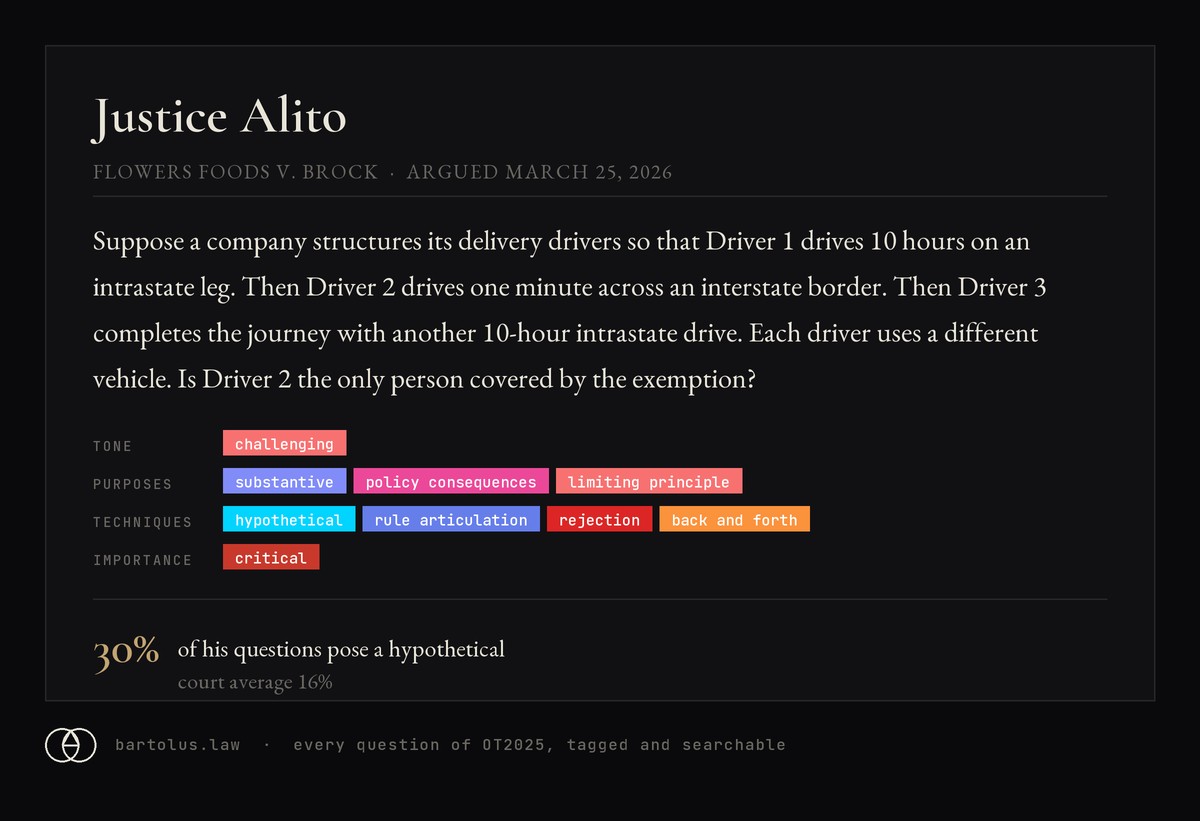
Bartolus takes arguments and tags each question by purpose, technique, and tone. It gives you an interactive hub where you can view how one judge asks hypotheticals, how another judge asks about the remedy, and how a third probes your limiting principle.
It then takes that data, and applies it to your briefs. You get a customized prep report, built around your panel, your subject matter, your record, and your arguments. It's the first product of its kind.
Nemo bonus iurista nisi bartolista.
Bartolus takes arguments and tags each question by purpose, technique, and tone. It gives you an interactive hub where you can view how one judge asks hypotheticals, how another judge asks about the remedy, and how a third probes your limiting principle.
We fed the same briefs to a generic AI and to Bartolus. Here is what each predicted the judge would ask in a res judicata case — and what he actually said.
Hundreds of iterations since the first report. Every improvement came from testing the product against what actually happened in court.
Backtesting. How do you score whether a prep report worked? By checking whether the judge asked questions the attorney wasn't ready for. Every report now comes with a backtest score — the percentage of the judge's actual questions that the prep report covered.
The record. A judge once asked about a person neither brief mentioned by name. That question is why every report now includes a Record Vulnerability Audit — flagging facts and third parties that could surface regardless of what either side argued.
Data transparency. If Bartolus doesn't have enough corpus data on a specific judge in a specific subject matter, the report says so. The report is directional, not predictive — and the distinction is labeled explicitly.
Bartolus was built by someone who has been in the courtroom as a clerk, an observer, and an advocate.
Free to explore
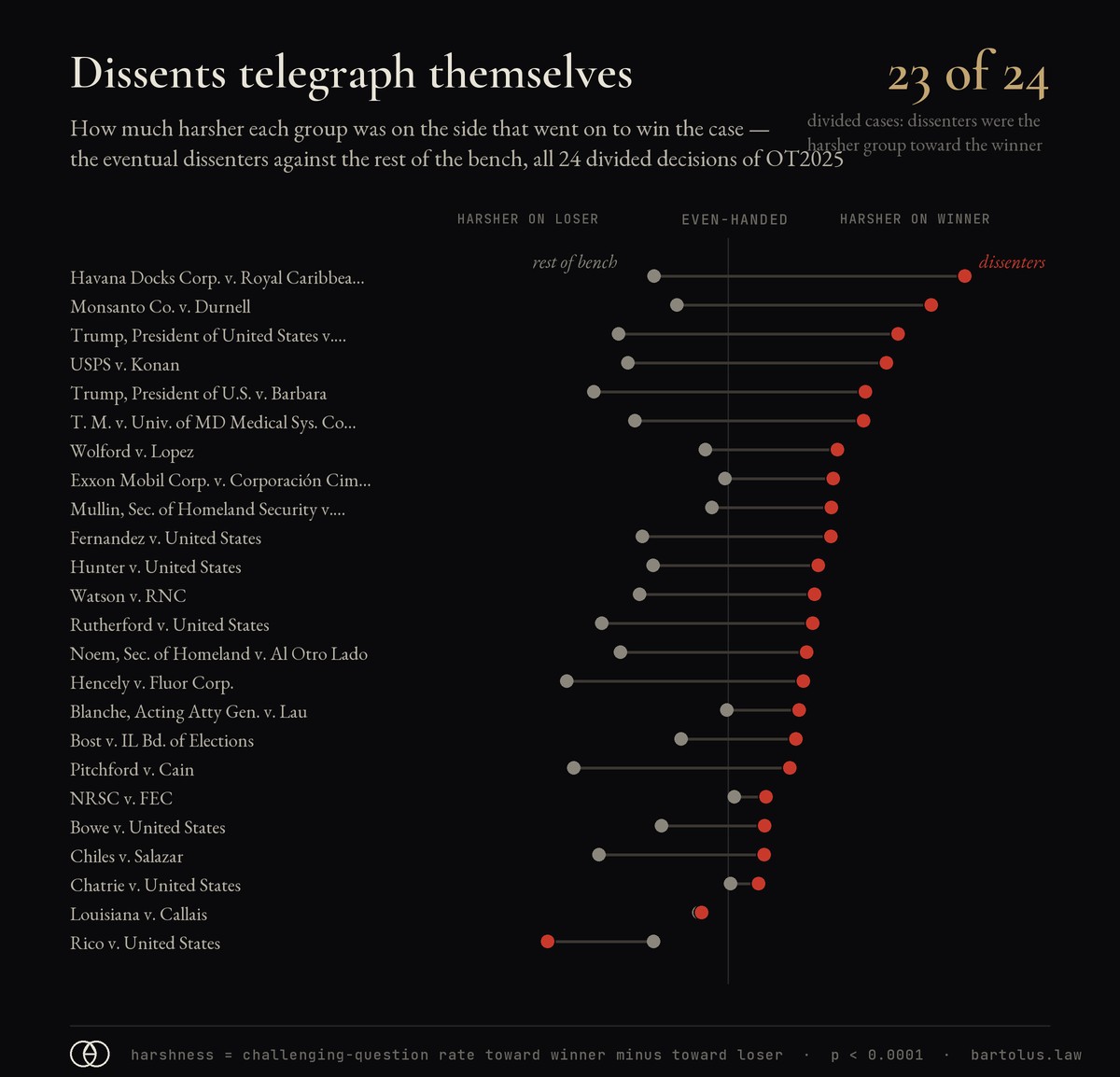
An interactive behavioral profile of all nine justices across the current term's oral arguments. Explore the methodology before committing to a report.
Oct. Term 2025 · All nine justices · 58 cases
Every argument, every question — tagged by technique, purpose, and tone. Dive in and explore.
The team
Bartolus is a product of Greil Analytics LLC.
John Greil
Founder · Greil Analytics LLC · BartolusJohn Greil is a law professor and practicing appellate attorney. He has argued at the federal circuit and state supreme court level, clerked at the federal appellate level, and holds a J.D. from Harvard Law School. He built Bartolus because he wanted a prep tool that could test empirical data against gut feelings — and couldn't find one that did.
The data is constantly improving and constantly evolving. Every category in the taxonomy has been tested against real argument. The methodology is transparent by design: if a judge has thin data, the report says so. If a prediction fired or missed in backtesting, the record is in the file. New tags are regularly added and refined.
This page is set in Cormorant Garamond, EB Garamond, and JetBrains Mono.
Get started
Available for arguments in any federal circuit and the Supreme Court. Turnaround is typically 48–72 hours once briefs are received.
If you have an argument coming up, reach out. Pricing available on request.
For firms interested in ongoing access, we are building a subscription product. Mention it in your message.
We stand behind Bartolus. We'll send the report before you pay. If it doesn't satisfy you, delete it. You pay nothing.
Tell us
We want to know what you think. Like the design? Disagree with a question tag? Technical bug? Product suggestion? We're listening.
Every note goes directly to the person who built this. We read them all.